
Interleaving: The Study Technique That Helps You Learn Faster (With Examples)
If you’ve ever practiced one type of problem repeatedly, felt confident, and then blanked on a mixed exam, you’ve run into a common trap: your practice didn’t teach you how to choose the right method.
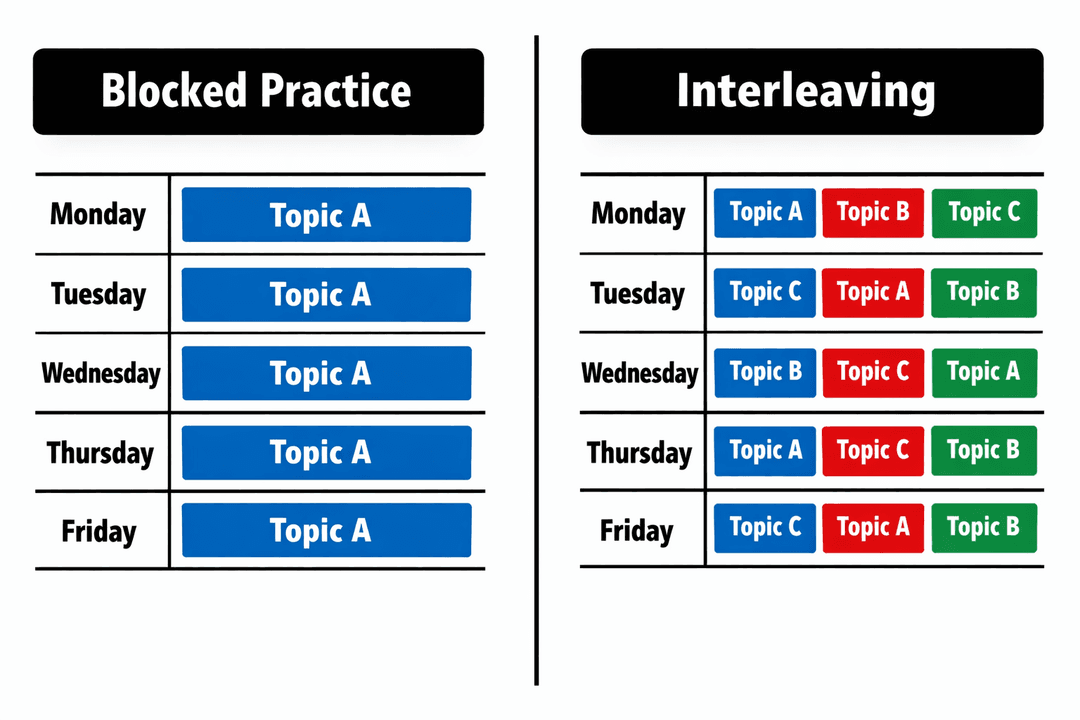
Interleaving fixes that. Instead of practicing one topic in a big block (A-A-A-A), you mix related topics or problem types (A-B-C-A). It can feel harder in the moment—but it often builds the kind of flexible understanding exams actually reward.
What interleaving is (and what it isn’t)
Interleaving means mixing similar skills during practice so you learn to spot which skill applies.
It is not:
- Multitasking (switching between unrelated tasks like studying and scrolling)
- Random chaos (mixing topics with no purpose)
- Cramming (doing everything the night before)
Interleaving works best when the items are confusable—similar enough that choosing the right approach is part of the challenge (e.g., algebra problem types, grammar rules, chemistry reaction classes).
Interleaving vs. blocked practice: why “harder” can be better
Blocked practice looks like:
- 20 problems of the same type
- One chapter at a time
- One formula repeated until it feels automatic
Interleaving looks like:
- A short set of different (but related) problem types
- Mixed review across chapters
- Practice that forces you to identify the right tool first
Here’s the core difference:
- Blocked practice trains execution (“Can I do this procedure again?”)
- Interleaving trains selection (“Which procedure should I use?”)
When interleaving helps most
Interleaving is most useful when success depends on diagnosis—reading a prompt and deciding what it’s asking for.
Common high-impact uses:
- Math: linear vs. quadratic vs. exponential, trig identities, geometry theorems
- Physics: choosing between kinematics, energy, momentum, circuits
- Chemistry: reaction types, equilibrium vs. kinetics, stoichiometry variants
- Language: similar grammar rules, verb tenses, commonly confused words
- Music/sports: mixing drills that share patterns (not totally unrelated skills)
If your subject is mostly memorization (e.g., anatomy terms), interleaving can still help—but it’s usually strongest when paired with spaced repetition and active recall.
How to build an interleaved study session (a simple recipe)
Use this 4-step template:
1) Pick 2–4 related “buckets”
Examples:
- Algebra: factoring, completing the square, quadratic formula
- Biology: transcription, translation, cell respiration, photosynthesis
- English: commas, semicolons, dependent clauses
Aim for “related but distinguishable.” If two buckets feel identical, you’ll struggle to know what changed.
2) Create short sets (not marathon mixes)
A good starting point:
- 12–20 total questions
- 3–6 per bucket
- Mixed order (avoid predictable patterns)
3) Add a “decision step” before you solve
Before writing any math:
- Underline key information
- Write the bucket name you think applies (one word)
- Then solve
This trains the skill interleaving is meant to build: method selection.

4) Review mistakes by cue, not by answer
Instead of “I got #7 wrong,” ask:
- What cue did I miss?
- What cue did I misread?
- What cue would tell me the right bucket next time?
This turns errors into a reusable checklist.
A concrete 7-day plan (example schedule)
Below is an example of interleaving for a math unit with three buckets (A/B/C). Keep sessions short and repeatable.
| Day | Focus | What you do |
|---|---|---|
| Mon | Learn | Work A in a small block (understand steps) |
| Tue | Mix | A/B mini-set (write the bucket first) |
| Wed | Learn | Work C in a small block (understand steps) |
| Thu | Mix | A/B/C mini-set + error review by cue |
| Fri | Mix | New A/B/C set with slightly harder questions |
| Sat | Test | Timed mixed set (exam-like) |
| Sun | Repair | Redo only missed cues + short mixed set |
Blocked learning still has a place early on (to understand a method). Interleaving is how you make that method usable when the test is mixed.
Common mistakes (and quick fixes)
- Mixing too early → Learn each bucket with 3–5 guided problems first.
- Mixing unrelated topics → Mix items that share similar-looking cues.
- No reflection → Add a 10-minute “cue review” after every set.
- Too much variety → Start with 2 buckets, then add a third.
- Feeling worse and quitting → Expect interleaving to feel harder; measure progress on mixed quizzes, not during practice.
How to combine interleaving with other proven methods
- Pair with spaced repetition: revisit the same buckets across days, not just in one session.
- Pair with active recall: close notes and retrieve the cues and method steps from memory.
- Use exam simulation: once per week, do a timed mixed set to practice selection under pressure.
Conclusion: make practice look like the test
If your exam mixes topics, your practice should too. Interleaving is a practical way to build the skill that separates good practice from great performance: recognizing what a question is really asking.
Start small (2 buckets, one mini-set), add a decision step (“Which bucket is this?”), and review errors by cue. In a week, your mixed-set accuracy should begin to rise—and the improvement tends to stick.